Scrubber system — wet chemical

Wet packed-bed scrubber LNS-SC-WET

Engineered chemical gas cleaning. A vertical packed-bed wet scrubber for corrosive gases, chemical vapours, industrial odours and water-soluble contaminants.

Product overview · LNS-SC-WET

Description

The LineSig LNS-SC-WET is a vertical packed-bed wet scrubber engineered for the removal of corrosive gases, chemical vapours, industrial odours and water-soluble contaminants from process exhaust streams. The system combines high-efficiency gas-liquid mass transfer with controlled chemical absorption, neutralisation or oxidation.

Scrubbing liquid is continuously recirculated through internal spray headers and packed media while the required chemical condition is maintained automatically via pH, ORP or conductivity control.
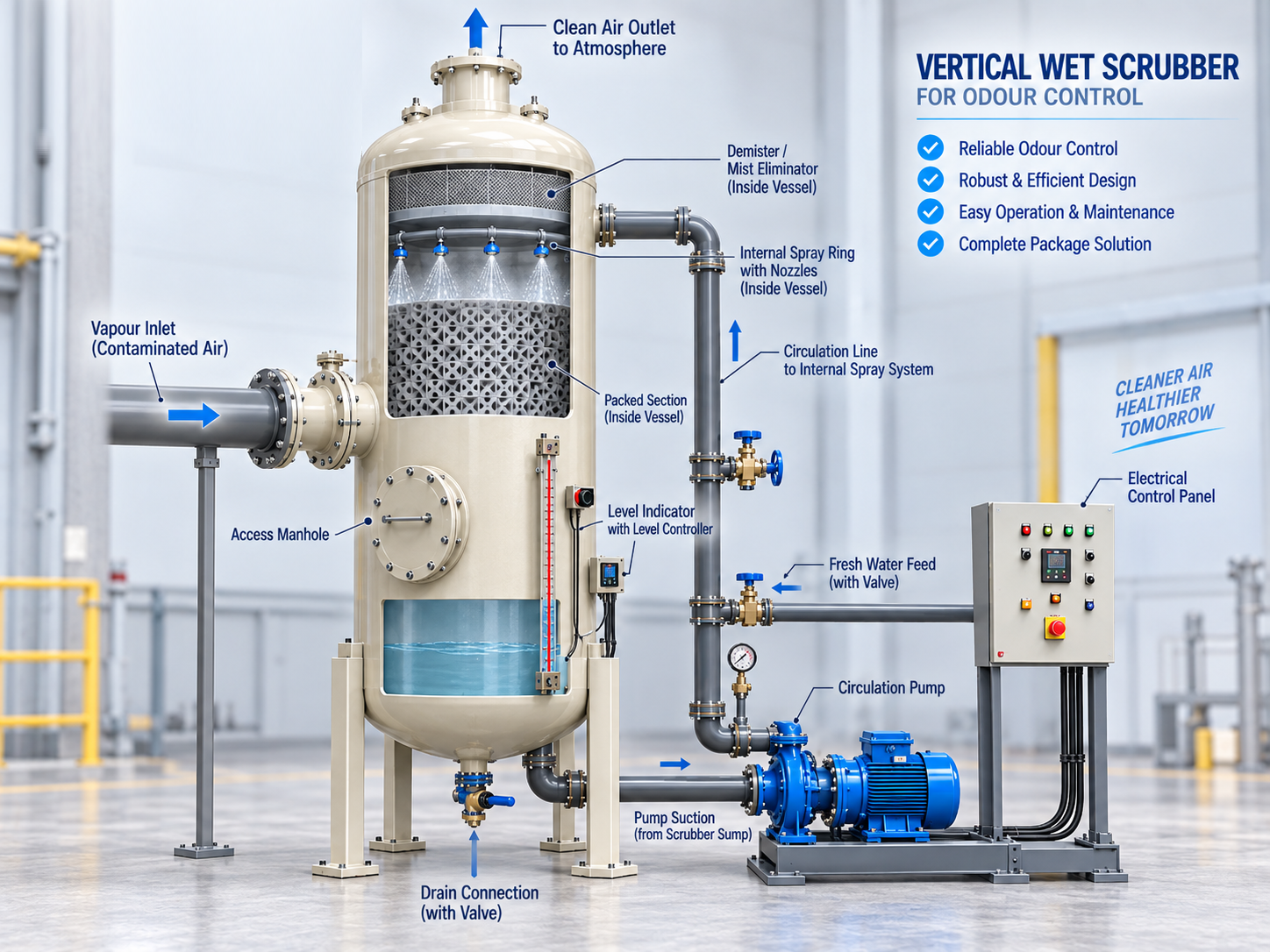
LineSig LNS-SC-WET wet packed-bed scrubber system

Typical contaminants

Hydrogen chloride (HCl), hydrogen fluoride (HF), sulfur dioxide (SO₂), hydrogen sulfide (H₂S), ammonia (NH₃), chlorine (Cl₂), mercaptans, amines, acid fumes, alkaline vapours, water-soluble VOCs, industrial odours and selected acid mists and soluble aerosols.

Process

How it works

  • Contaminated air enters the lower scrubber section and is distributed across the column
  • Gas travels upward through wetted packing (packed-bed absorption)
  • Contaminants dissolve into the circulating liquor and react with the selected reagent
  • Internal full-cone nozzles continuously wet the packed section
  • Entrained droplets are removed by the mist eliminator before discharge
  • Treated gas exits to the stack
  • Sump liquid is pumped continuously back to the internal spray system
  • pH, ORP or conductivity signals regulate chemical dosing and blowdown

Typical chemical operations

HCl / HF / SO₂NaOH or alkaline solution
NH₃Dilute acid scrubbing
H₂SNaOH + oxidizing agent
MercaptansAlkaline / oxidation chemistry
ChlorineAlkaline or reducing treatment
Acid mistWater / alkaline solution
Soluble VOCsWater or application-specific liquor
Mixed odour gasesSelected neutralisation / oxidation chemistry

Final reagent selection should always be based on actual gas composition, inlet concentration and discharge requirement.

Design

Key benefits

  • High gas-removal efficiency, compact vertical packed-bed design
  • Suitable for corrosive industrial gases
  • Multiple chemical-treatment modes, low pressure-drop packing
  • Uniform internal spray distribution
  • Automatic fresh-water make-up, pH / ORP / conductivity control
  • Automatic chemical dosing, controlled blowdown
  • High-efficiency mist elimination, corrosion-resistant construction
  • PLC/HMI automation, single-stage or multi-stage configuration

Available configurations

  • Water scrubber — for highly water-soluble contaminants
  • Alkaline scrubber — for acidic gases
  • Acid scrubber — for ammonia and alkaline vapours
  • Oxidizing scrubber — for H₂S, mercaptans and selected odours
  • Two-stage scrubber — when different contaminants require separate chemical reactions
  • Venturi + packed bed — where particulate or aerosol removal is required before absorption

Technical specification

Typical construction options

Scrubber shellFRP/Vinyl Ester, PP, PVC, PVDF, SS316L
PackingPP / PVDF
Spray pipingPP / PVC / PVDF
Spray nozzlesPP / PVDF / SS
Mist eliminatorPP / PVDF
PumpsPP / PVDF / SS / FRP-lined
PipingPP / PVC / PVDF / FRP / SS
SkidCoated CS / SS
Control panelPainted steel / SS304 / SS316

Control & automation: PLC/HMI control, automatic sump-level control, fresh-water solenoid/control valve, recirculation flow monitoring, pH/ORP/conductivity-TDS monitoring, automatic chemical dosing and blowdown, packed-bed differential pressure, blower VFD control, pump duty/standby changeover, local/remote operation, alarm history and SCADA/DCS communication.

Where it's used

Industries & applications

  • Chemical & petrochemical — reactor vents, process tanks, storage vents, chemical handling
  • Fertilizer & ammonia plants — NH₃ and alkaline gas treatment
  • Metal pickling & galvanizing — HCl, H₂SO₄ and acid-fume removal
  • Wastewater treatment — H₂S, ammonia and odour control
  • Pulp & paper — sulfur compounds and chemical vapours
  • Textile & dyeing — acid and alkaline process fumes
  • Food & rendering — odours, amines and soluble process vapours
  • Battery/recycling & bulk chemical storage — acid mist, tank breathing and transfer vapour treatment

Downloads

Documents